
If you’re new to homeschooling, planning out your entire school year may seem daunting at first. Some curriculums have 180 lessons, some have only 150, some go by lesson weeks instead of days, and how do you fit in a unit study? And that’s just the general year plan. What if you want to do science and history on alternating days? And what about co-ops and other extracurricular activities? And teaching multiple kids?! It can begin to get overwhelming very fast. But it doesn’t have to be! I’ll walk you through our yearly homeschool planning process step by step, and show you how you can have your year planned in one afternoon.
Look at Your Calendar
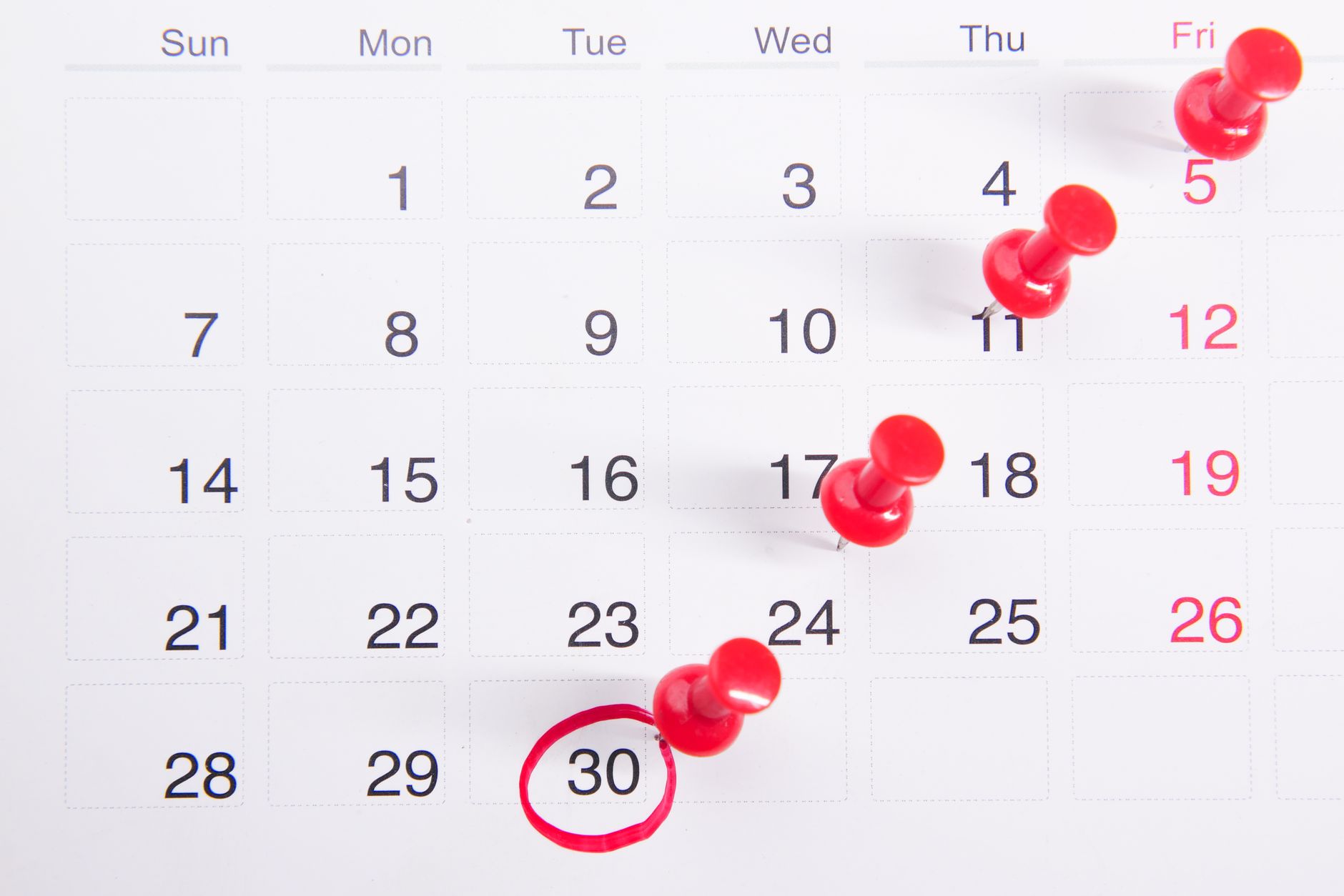
Homeschooling is different from in-person school in that it is an extension of your family life. You don’t need permission to take a vacation in October and there are no rules that say summer vacation HAS to be in June and July. Pull out your family calendar and look at your current plans, appointments, vacations, family obligations, co-ops, etc. Decide which days you will not be doing school and see if there are any natural breaks or ideal start/end dates for your school year. (If you are in a state or country that requires a minimum number of attendance days, make sure that you are meeting your requirements.)
Our family schools year-round. This means we do not take a summer break, and we often don’t take other “standard” breaks. But I know that the Christmas and New Year holidays are busy for us, and so I decided that I did not want December to be the start of a new grading period. It didn’t make sense for us to start a new grading period only to be interrupted three weeks in. So, we decided that October would be the start of our school year, and thus our year is broken up into the following four grading periods (quarters):
Quarter 1: October-December
Quarter 2: January-March
Quarter 3: April-June
Quarter 4: July-September
Now, I’m not saying that you should be homeschooling year-round, that’s another post for another day. But decide when you are starting and ending and divide the year into your desired grading periods. (You can have a different number of grading periods too! Some go the semester route, others the trimester, and I’ve seen some families break their year into 6 grading periods. Do what works for you!)

Look at Your Curriculum
Now that you have an idea of the timeline for your school year, look at each curriculum to get an estimate of how many days are needed to complete the curriculum. This will vary between company and subjects. Take the estimated number of days and divide it by the number of grading periods you have to get a rough idea of how many lessons you need to complete each grading period. This is just an estimate, but its typically pretty close to what you need. You can do this with unit studies too. Most pre-made studies come with a recommended number of days to completion, and you can decide to split the study up over multiple grading periods, do it in one grading period or even complete more than one study in a grading period.
In our homeschool, our math curriculum has only 130 lessons while our language arts curriculum has 170 pages. This means that in each grading period, we need to complete roughly 32 math lessons and 42 language arts lessons. I write down the rough last lesson of the grading period (I call them ‘target lessons’), but I can see from the start that I have a LOT of wiggle room in math. If a math lesson needs to take two days instead of one, I don’t worry about getting “caught up” because I know already that we have plenty of time.
It is also important to know that for older students, the target lesson will probably need to be adjusted. I like to end my grading periods with the end of quarter test that many of our curriculums come with. That test should be fairly close to the target lesson, but I might need to adjust by a lesson or two. For example, our first grading period math test this year was on lesson 35, so we stretched quarter one’s target lesson from 32 to 35. I don’t stress about doing all of this at the beginning of the year. At the beginning of each quarter, I can look at the exact test lesson and just adjust the target lesson accordingly.
If you are working on independent learning as a skill for your students, it is also a good idea to communicate these target lessons with them. You can show your students how to set up a personal calendar or planner, how to keep up with assignments, and give incentives for hitting their target goals on time. This is a necessary and often overlooked skill, but time management and the ability to hit target dates are needed in dual enrollment, higher education, and many workplace careers.
In this step of the planning process, you may realize that you have picked too much to do in one school year. Remember that doing too many things is one of the fastest ways to homeschool burn out. Our first-year homeschooling, I had planned to do about 4 different unit studies on top of our regular curriculum. Giving target dates to the curriculum and studies this way allowed me to see that I did not have enough time to do everything I wanted to do. I was able to pick the one unit study that was most important to us and fit it in with our existing curriculum. We had a great time, and I don’t regret doing fewer studies so that we could enjoy our homeschool year more.

Create Your Weekly Plan
You know your important school calendar dates; you’ve created target lessons for each course and now you can create your weekly plan. Want to do science on Tuesday and Thursdays? No problem! Just double check that you can do that and still hit your target lesson. If you don’t hit your target lesson, you get to decide how you want to remedy that. You might do two science lessons on Tuesday or decide that on Fridays you’ll need to do science too. You might realize that you picked a really rigorous science curriculum and you need to do science 5 days a week. That’s okay too. You can give it a try for the first grading period and re-evaluate your homeschool needs at the start of the second grading period.
In our homeschool, most core courses are done 5 days a week, but math is only done 4 days a week and our electives are done on a loop. Math is normally skipped on Friday, but if an appointment came up, we could skip math on the appointment day and do it on Friday instead. For electives, the general plan is that we will do 2 electives every day, but sometimes that doesn’t happen and I don’t stress about it. We just loop through the list and do what we can.
Decide How Rigid You Will Be
Sometimes life throws you a curve ball. Things happen that are out of your control and it wrecks the best laid plans. Before your school year is really underway, you need to decide how rigid your school plans will be. Some families need their school year to be fixed. They will do school on the weekends to catch up to their target dates, they’ll do double lessons one day, they’ll cancel vacations to finish school. And there’s nothing wrong with those things if that’s what your family needs. Other families might be way less rigid and are comfortable with not finishing a curriculum and not completing their target dates.
We are somewhere in the middle of the extremes. I do want our children to complete their curriculums, but I don’t want to be doing school on a Saturday. I am willing to be 5 lessons behind our target date, but no more than that. We will do double lessons as needed to catch up. Toward the end of the grading period, when a target goal for a subject is reached, then that subject is finished for that grading period. If math is finished by December 12, then we will not do math again until quarter 2 in January. This means that our end of quarter school days are often short. If another subject needs to have lessons done twice a day to catch up, we can do it then. But it’s not a surprise to our children if we say that today is a double history day. They know where we are behind, and they know that it is important to us that they be close to their target goals.
Plan the Fun!
Unless you have an extremely busy extra-curricular schedule, you should now be able to see the times of the year when you will have time for fun extras. For us, it’s the end of each grading period as we’ve hit our target lesson goals. These are the times when we take fun days out to the beach or park, or we try to go to the zoo or a museum. We are able to get amazing experiences worked in without stressing over our unfinished assignments. School does not go with us on these days out. These days are purely for learning and connecting with each other. And putting them at the end of the grading period is what allows us to do that.
Create a list of fun things and keep it tucked with your regular planning supplies. When a free day pops up, you’ll have a ready-made list of ideas for your fun day off. If your kids are older, they can help you create this list. You might be surprised at what activities your children consider a fun day out.

I hope this was helpful! I know it might seem backwards to look at the whole year and then work toward your weekly and daily schedule, but it really helps ensure that all of your goals can be met. You have all of the information that you need to plan, schedule, and execute a successful homeschool year. You can do this! Happy homeschooling!


Leave a Reply